i. Background.
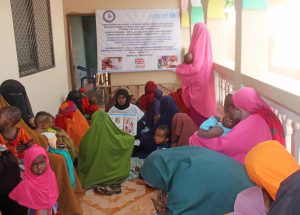
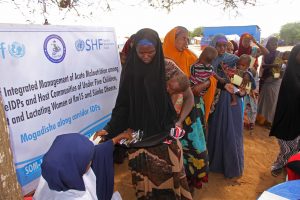
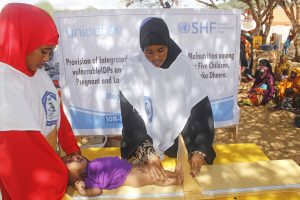
Somalia Young Doctors Association (SOYDA) is steadfast in its implementation of health, WASH and nutrition program in Banadir and Lower Shabelle region. SOYDA is currently running a total of 11 health and nutrition fixed and Mobile sites, 8 Mobile outreach Integrated WASH, HEALTH, NUTRITION emergency response teams in Daynile, Bondhere, Dharkenley, Afgooye, Arbis, KM 13, Km15, Lafole, Elasha, Siinka Dheer IDPs. However, in the past months the program progress was in line with the planned activities and indicators set out in the program documents.
Despite improved scale up of health and nutrition activities the target areas in Afgooye district and Mogadishu IDPs still have high number of children with SAM and MAM cases. However, this was attributed to the limited livelihood services that could have otherwise integrated within the nutrition and health programs.
In this reporting month, there is a minimal risk of AWD/cholera outbreak compared to the previous months and hence SOYDA shall continue its program implementation to enable reduce the vulnerability as well as provide improved lifesaving nutrition and health services.
SOYDA acknowledges the great support from Ministry of Health, FGS, SHF, UNICEF, and DFID-UK AID for the smooth implementation of SOYDA activities.
i. Program activity achievement.
The following were some of achievement recorded in this Month, they includes:
• Through the leadership of the Federal Ministry of health and UNICEF, SOYDA was able to facilitate the conduct of EPI micro planning training to 119 participant drawn from Juballand administration, Galmudug, South west state and Banadir region of Somalia, SOYDA organization was however, honored to conduct such important activities with the trust of the Ministry and other donors.
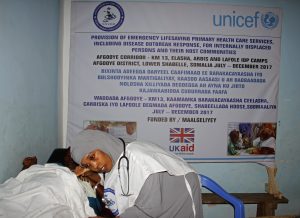
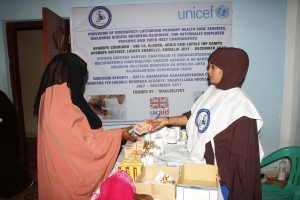
• A total of 16,378 number of crisis affected women, children and Men in emergency was reached with improved life-saving primary health care services, However, integration of nutrition and health have helped the community members have better lifesaving nutrition and health services with easy access to the facilities and mobile clinics.
• In this reporting months with support of SHF, SOYDA was able to facilitated IMAM training to 39 participant across all its program, this was aimed in improving the skills and knowledge of technical program staff hence successfully deliver the services to the vulnerable population in the target areas.
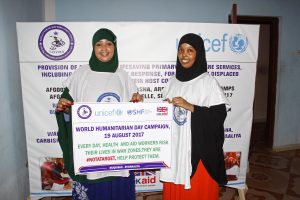
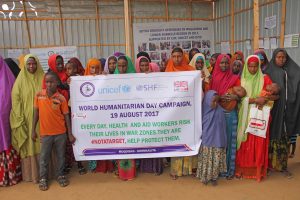
• SOYDA in its continuous support to humanitarian goals and objectives in better health and nutrition services delivery was able to conduct world humanitarian Day on 19th August, 2017, in Mogadishu, this was a platform in sharing the humanitarian services delivery as well as sharing the lesson learnt and challenges in Somalia humanitarian service delivery context. The event was colorfully conducted by SOYDA as committed partner in health and nutrition.
• Through its advocacy in child nutrition and development SOYDA was able to spearhead the world breastfeeding week that was conducted on 1-7th August 2017 at Mogadishu Somalia. SOYDA been the national lead agency in health and nutrition services delivery was able to provide the necessary facilitation for breastfeeding week in Banadir and Afgooye Corridor.
• Through the continuous capacity development and on job training of the technical and project staff the project was able to provided capacity development and training opportunity to project staff through which it has conducted integrated management of childhood illness, measles and cholera treatment prevention training to 40 participants across SOYDA ongoing programs hence provided an opportunity for the capacity enhancement to all the target project staff in Banadir and Lower Shabelle region with support of SHF Somalia.
• Through the facility and outreach program sites SOYDA was able to reach a total of 2769 children under five boys and girls for vitamin A supplementation, however, the program was able to reach more than monthly target hence indicating better progress for the program indicators achievement
• SOYDA has continuously conducting routing measles immunization in all the project target sites for health and nutrition however, in this reporting months, it was able to reach a total of 1,487 children segregated into < children boys, girls, <1 year 396 and >1091. This has since improved the quality of the target beneficiaries in all the program areas.
• In this reporting Month, the project was able to provide continuous Pentad 1 and 3 targeting under five children hence a total of 898 children were provided with Penta routine immunization.
• Skilled delivery is the core of primary health care services thus the project was able to record success in both facilities and at home visit for the traditional birth attendance hence encourage facility delivery and passed knowledge and information to the mothers in the target areas for safe motherhoods hence this reporting month total 219 safe delivery were conducted in SOYDA health and Nutrition facilities. This improvement was also attributed closer coordination between the program outreach team as well as community traditional birth attendants in the project areas.
• In this reporting period a total of 1876 pregnant and lactating mothers have attended antenatal care (ANC 1st visit) in this reporting period and has since completed all the 4 comprehensive ANC visit. The program has recorded success in all reaching the vulnerable mothers with improved maternal health care services in both facilities and outreach sites program.
• On the same reporting period a total of 182 of pregnant women have received TT1-5, hence improving the protection of mothers and Fetus birth spacing knowledge. Also 21 non-pregnant were provided the TT vaccine. The community health workers are continuously conducting community sensitization and education in the project areas.
ii. Challenges/Constrains.
Some of the bottlenecks experience during this reporting period is as follows:
• Limited sanitation facilities in the target IDPs and host communities in the target district hence poor hygiene and sanitation promotion services.
iii. Lesson learnt.
The following were some of the lessons learn during this quarterly reporting period.
• Strengthen and improve nutrition communication and advocacy through National and sub national cluster. Sustaining nutrition communication and advocacy will be imperative for all actors to be actively engaged. Local partners and MOH-Federal to be supported in their efforts to track nutrition activities and ensuring that resources focus on regions with poorest nutrition outcomes.
• Foster research, information sharing and cross learning. National partners at district level have limited resources and capacity to implement Nutrition & health Information Platforms, which would enable stakeholders to discuss current and foreseeable nutrition issues and to share evidence on what works. Support to local organization from the donors and development partners to conduct research and hold Nutrition Information Platforms would help to contextualize local needs as well as foster local participation