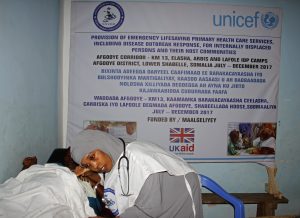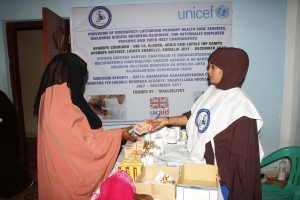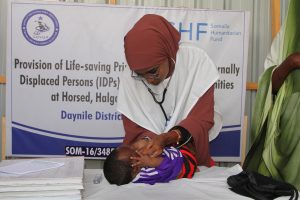
The overall program management was assured by strong capacities in planning, implementation and monitoring through a very qualified and well-organized team and leaderships in Lower Shabelle and Banadir region. It worked through integration of health programs in which SOYDA was also in partnership with SHF, DFID and UNICEF Somalia..
The program adopted an effective participatory approach for assessing community needs and designing the interventions. The technical designs and choice of interventions considered the needs of the beneficiaries and technical viability of the structures in the different geographical locations. Supplement distribution (RUTF) involved the beneficiaries directly by engaging them through mobile and static nutrition interventions as well as mobile clinic, an excellent approach that provided immediate lifesaving and life sustaining health and nutrition intervention in the target locations.
The program produced important immediate results that show high prospects for larger impacts. Within its limited scope, the program reached vulnerable households as well as enabling equitable access to essential health and nutrition services. During the program implementation, the community members expressed their satisfaction, and it was clear their relationship was very good. The community nutrition education improved health and nutrition seeking behaviour of the communities, through the effective community health workers engagement on daily screening and referral as well as the traditional birth attendance who have visited the homes time to time in order to ensure the pregnant mothers deliver safely at SOYDA facilities.
Through the community health workers the project was able to reach the community members and provided the services to their doorstep, this has led to decreased in AWD/cholera related disease reported high before the initiation of the project.
i. Program activity achievement.
The following were some of achievement recorded in this months, they includes:
• A total of 14,678 number of crisis affected women, children and Men in emergency was reached with improved life-saving primary health care services, However, integration of nutrition and health have helped the community members have better lifesaving nutrition and health services with easy access to the facilities and mobile sites.
• Through the facility and outreach program sites SOYDA was able to reach a total of 2879 children under five boys and girls for vitamin A supplementation to enable enhance the vulnerable children nutrition status. This has since be able the program to reach more than 85% of the monthly coverage under five children thus indicating greater progress to the set indicators within the program.
• SOYDA has continuously conducting routing immunization in all the project target sites for health and nutrition however, in this reporting months, it was able to reach Routine measles immunization in both the facility base as well as outreach mobile services hence the program have been able to reach a total of 2, 112 children. This has since improved the quality of the target beneficiaries in all the program areas.
• Skilled delivery is the core of primary health care services thus the project was able to record success in both facilities and at home visit for the traditional birth attendance hence encourage facility delivery and passed knowledge and information to the mothers in the target areas for safe motherhoods hence this reporting month a total 296 safe delivery were conducted in SOYDA health and Nutrition facilities. This improvement was also attributed closer coordination between the program outreach team as well as community traditional birth attendants in the project areas.
• The project was able to attend to a total of 1,766 pregnant and lactating mother’s antenatal care (ANC 1st visit) in this reporting period and has since completed all the 4 comprehensive ANC visit. The program has recorded success in all reaching the vulnerable mothers with improved maternal health care services in both facilities and outreach sites program.
• On the same reporting period a total of 271 women of reproductive age have received T1-T5. The community health workers are continuously conducting community sensitization and education in the project areas.
• Through this reporting months a total of 1358 <5 children received penta 1-3 in both the mobile outreach project sites as well as the facility base program sites, this has since provided the target beneficiaries enhance access to feasible emergency integrated nutrition and primary health care services.
•
ii. Challenges/Constrains.
Some of the bottlenecks experience during this reporting period is as follows:
• Limited funding with high number of beneficiaries in the program sites. This is due to the short time program funding, Particularly the end of SHF Nutrition fund in Km15 and Siinka Dheere
• High number of displaced person from drought affected areas.
iii. Lesson learnt.
The following were some of the lesson learns during this quarterly reporting period.
• Strengthen and improve nutrition communication and advocacy through National and sub national cluster.
• Supportive supervision and closer coordination with Federal MOH and other humanitarian actors have provided better service delivery as well as improved project staff capacity hence sustaining nutrition communication and advocacy will be imperative for all actors to be actively engaged. Local partners and MOH-Federal to be supported in their efforts to track nutrition activities and ensuring that resources focus on regions with poorest nutrition outcomes.